
Sports Psychologist in Minneapolis, MN
We train the other half of the athlete
You want to work on your mental game, but how do you train your brain?
Mental training does not get much media attention, but at MindBalanceSPORT we know it is a game changer. The mental skills you will learn at MindBalanceSPORT are generalizable in the classroom, in sport and in life!
We know that mental skills can be successfully taught, even at an early age.

Our Services






Meet the Team




testimonials
Athlete Stories: Real Comebacks, Real Results

Emma, a high school basketball player, tore her ACL in the middle of her junior season. After surgery, she struggled with self-doubt and fear every time she stepped back on the court. Through sport psychology training, she learned visualization techniques and confidence-building exercises that helped her regain trust in her knee. When she returned for her senior season, she didn’t just play—she led her team to the playoffs.

Carlos, a soccer player, suffered a stress fracture in his foot and had to miss half of his season. Sitting out was mentally tougher than the pain itself. We worked on mental engagement strategies to keep him sharp—studying game film, setting small rehab goals, and using mental imagery to stay ready. When he was finally cleared, his confidence never wavered.

Jordan, a track athlete, strained her hamstring before a major competition. She feared losing speed and falling behind competitors. Instead of focusing on what she couldn’t do, we redirected her energy toward mental preparation, using self-talk and goal setting to keep her confidence strong. When she returned, she set a new personal record.
EXCELLENT Based on 30 reviews
 Posted on Google
 hank rochetteI decided to work with a mental performance coach because I struggled with self-doubt around my race-day performance. I wanted to understand where those doubts came from and learn how to show up with greater confidence, focus, and certainty. Working with Brady has been a game changer. Through our work together, I now approach races feeling more relaxed, confident, and focused. Some of the most valuable tools I've developed include creating an alter ego for race day, understanding the difference between my internal and external scoreboards, and developing my personal pain pledge. These strategies have helped me perform with a stronger mindset and enjoy the process more. If you're looking to show up to your event, game, or race with greater confidence, certainty, and mental resilience, I highly recommend working with a mental performance coach—and Brady has been an outstanding guide throughout that journey.Posted on Google
 Ella ConnorI found my time at MindbalanceSPORT SUPER helpful. I improved a lot with my confidence in my own play and working on taking steps to reset after mistakes and in between points. This helped me achieve a lot more than I thought I would be able to. We were also able to create some impactful morning routines with meditation and mindfulness. I would highly recommend!!Posted on Google
 Nancy YasalonisWhat a great experience! Recently we had Brady Dinnsen work with our volleyball team to discuss various aspects of mental toughness. Some of the topics that were super helpful were Self-talk, Confidence, Next point mentality and Finishing. Brady would be an asset to any team looking to improve in these areas.Posted on Google
 Vicki AnagnostopoulosThis practice is doing amazing things for young athletes. I have had a top notch experience collaborating with providers at Mind Balance Sport. As a psychologist who does a lot of the clinical work with student athletes, the added component of mental performance coaching really catalyzes growth and well-being. I highly recommend.Posted on Google
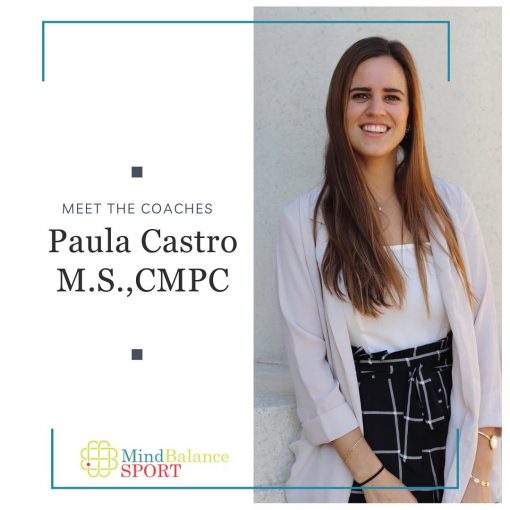
 Kristin HumeI am a marathon runner with some big goals for myself. In my last three marathons, I’ve struggled with some serious mental blockers in the later miles, and I’ve disappointed myself. In just 3 sessions so far, Paula has shown me how much my mental game is slowing me down. She’s armed me with actionable strategies to tackle my mental demons so that I can achieve what I think I am capable of. More than that, she’s helped me recover my “why” so that I can find joy in running again. She has been life changing. I am a 9x marathoner, yet I didn’t realize how much our mindset can shape our running experience, and how critical it is to train our brains along with our bodies. She’s getting me ready to take on my second Boston marathon this spring, and I can’t wait!Posted on Google
 Jacey SprattMy daughter (now 13) is a highly motivated and dedicated competitive gymnast who currently changed 16 hours a week. We hired Paula Castro a couple of years ago to work with her, as she was struggling with the stress/expectations of meets as well as some of the dynamics in the gym. Paula was a godsend; she helped make competitions more enjoyable/less stressful for her. She also provided useful tools and strategies that despite her young age, really resonated with her. My daughter attributes her gymnastics advancement in large part due to her work with Paula. We could not recommend her more highly and hope to work with her again in the future.Posted on Google
 Lauren WoolbertMy daughter and I loved working with Paula! I was worried that my kid may be too young, but it was so helpful to really find what the sport means to my daughter. And now we have several tools we can use in different situations to help re-focus and strengthen her mental game. We will definitely be calling her back if and when we hit an inevitable rough patch!Posted on Google
 Josh NotesIt has been great to use their guidance, tools and support to help our pre-teen athlete with mental focus and emotional regulation during competition.
Recovery
While Everyone Has A Physical Ceiling, There Is No Mental Ceiling.
Insights from Sports Psychologists in Minneapolis, MN: Strategies to Overcome a Losing Streak
Exploring the Importance of Sports Psychiatry in Minneapolis, MN
The first step to overcoming a losing streak is accepting it. Denial only prolongs the negative feelings and hinders progress. Acknowledge the loss but remember that it doesn’t define your potential or worth as an athlete.
Locating a Sports Psychologist Near Me for Mental Reconditioning
Sports psychology emphasizes the significance of mental strength in performance. Negative thoughts can materialize into physical limitations, causing poor performance and more losses. Practice positive self-talk and visualization exercises to boost confidence and keep your mind focused on success.
3. Set Realistic Goals
Setting excessively high goals can lead to disappointment, while setting them too low creates complacency. Sports psychologists recommend setting SMART (Specific, Measurable, Achievable, Relevant, Time-bound) goals that provide motivation without overwhelming you.
Specific | Clearly define what you want to achieve |
Measurable | Track progress with quantifiable outcomes |
Achievable | Ensure the goal is within reach |
Relevant | Align goals with your overall objectives |
Time-bound | Set a deadline for achieving the goal |
4. Focus on Process Over Outcome
In sports psychology, there’s a distinction between process-oriented thinking and outcome-oriented thinking. Rather than worrying about winning or losing (the outcome), focus on executing each step effectively (the process). This approach fosters better concentration during games and reduces performance anxiety.
5. Seek Professional Help
Finally, consider consulting with a sports psychologist. They can provide valuable guidance tailored specifically to your needs and help you navigate through the emotional toll of a losing streak.
By employing these strategies derived from sports psychology, you can transform a losing streak into a learning opportunity and embark on the path to success. Remember: losses are temporary, but the lessons learned from them are invaluable.
Top Sports Counselling Services in Minneapolis, MN: An Athlete’s Guide to Success
It can be excruciatingly frustrating for an athlete when they find themselves stuck in a prolonged losing streak. Every loss adds a layer of negativity, doubt and hopelessness, often leading to a significant blow to their self-esteem. While it’s natural to experience occasional losses in sports, a persistent losing streak can be challenging to overcome.
1. Acknowledge the Situation and Accept It
The first step towards overcoming any challenge is acknowledging it exists. Once you accept the situation, it can help reduce the emotional burden and pave the way forward for problem-solving.
- Recognize your feelings: Don’t suppress or deny your emotions.
- Accept that losses are part of any sport: Every athlete faces defeat at some point.
2. Set Realistic Goals
Goals provide direction. Having goals help athletes remain focused on their path towards success, instead of getting distracted by temporary failures.
- Define short-term and long-term goals: Short-term goals can serve as stepping stones towards long-term achievements.
- Goals should be SMART: Specific, Measurable, Achievable, Relevant and Time-bound.
3. Develop Mental Toughness
Mental toughness is crucial for athletes as it enables them to bounce back from losses or adversity more swiftly.
- Practice resilience: Learn to cope with adversity effectively.
- Work on improving focus: Avoid distractions that may lead you away from your goals.
4. Embrace Positivity
A positive attitude is key to breaking a losing streak because it helps maintain motivation levels despite setbacks.
- Cultivate an optimistic mindset: It promotes perseverance during tough times.
- Engage in positive self-talk: Encourage yourself throughout the journey with uplifting words and affirmations.
5. Seek Professional Help
If a losing streak continues to persist, it might be beneficial to seek assistance from a sports psychologist. They can provide personalized strategies and techniques tailored to your individual needs.
- Work on skill improvement: Sports psychologists can help identify areas of weakness and suggest ways to improve.
- Develop coping mechanisms: They can also assist in creating healthy coping strategies for handling stress and disappointments.
Remember, every athlete experiences losses; what sets champions apart is their ability to learn from each setback, bounce back stronger, and keep pushing towards their goals. A losing streak is not indicative of your potential or value as an athlete. Instead, it’s an opportunity for growth, improvement and introspection. By implementing the above-recommended strategies, you will gradually see improvements not only in your game performance but also in your mental strength and resilience.
Unlocking the Power of Performance Psychology in Minneapolis, MN
Sports, like any other discipline, are susceptible to periods of triumph and droughts. One aspect that distinguishes successful athletes from others is their ability to identify and rectify their shortcomings during a losing streak. This process requires introspection, evaluation, and amendment – a skill set that lies in the realm of self-analysis.
Adopting self-analysis can be transformative for athletes experiencing a losing streak. It’s not just about scrutinizing what happened during the game, but also about assessing preparation methods, mental state, physical condition, and personal life situations which might be impacting performance. Here’s how athletes can leverage self-analysis to discern the root cause of their losing streak.
Understanding Sports Performance Analysis
In sports psychology, performance analysis refers to the systematic observation of athletic performance to enhance decision making and improve overall effectiveness. This methodical approach helps athletes understand their strengths and weaknesses to make necessary adaptations.
Components of Self-Analysis
- Technical Analysis: Reviewing your playing techniques and strategies used in games.
- Tactical Analysis: Evaluating your understanding and application of game tactics.
- Physical Analysis: Assessing your physical condition including fitness level, strength, agility etc.
- Psychological Analysis: Examining your mental state during games.
By analyzing these aspects individually and collectively, an athlete can gain insights into areas needing improvement.
Steps for Effective Self-Analysis
- Identify Key Performance Indicators (KPIs): Outline specific measures such as speed or accuracy that are critical to your sport.
- Record Game Performances: Capture footage or note down crucial game moments for review.
- Evaluate KPIs Post-Match: Analyze your performance against the pre-set KPIs.
- Develop an Action Plan: Based on the evaluation, devise a plan to improve those factors that contributed to the losing streak.
The Role of Reflective Practice
Reflective practice is a crucial element of self-analysis. It involves reflecting on actions, analyzing emotional responses, and making changes accordingly. For example, how you react to losing points in a game can provide insights into your mental toughness or lack thereof.
Engaging in regular reflective practice can help you manage emotions better and respond more positively to setbacks.
Overcoming Barriers to Self-Analysis
While self-analysis is powerful, it isn’t easy. Some athletes may resist it due to fear of confronting their weaknesses or out of sheer complacency. However, overcoming such barriers is essential for performance improvement. One strategy is to see criticism as an opportunity for growth rather than as a threat.
The process of self-analysis requires commitment and honesty but can yield significant benefits, including identifying the root causes of a losing streak. By understanding the deeper issues impacting performance, athletes are better equipped to make relevant changes and return stronger than before.
Exploring Sport Performance Training in Minneapolis, MN: A Key to Enhanced Athleticism
In the realm of sports, a winning streak can be as thrilling as a losing streak can be crushing. However, from a sports psychology perspective, breaking the cycle of consecutive losses is often linked not only to an athlete’s physical prowess but also their mindset. This section will delve into the importance of mindset transformation in overcoming losing streaks.
The Power of Perception
- Start by acknowledging your feelings and fears.
- Identify any negative thought patterns.
- Challenge these thoughts: Are they rational or based on emotions?
- Replace them with positive affirmations: “I am capable,” “I learn from each game,” etc.
Emphasizing Learning Over Winning
- Understand that losing does not equate to failure.
- Recognize that each game is a chance to improve your skills.
- After each match, note what worked well and what didn’t—use these insights for training.
Resilience Training
- Develop techniques for managing stress such as deep breathing exercises.
- Practice mindfulness exercises like meditation to help remain calm under pressure.
- Gratitude exercises can help maintain a positive outlook.
Cultivating a Growth Mindset
- Understand that abilities are not fixed and can be developed.
- Interpret challenges as opportunities to grow.
- Embrace feedback and criticism as tools for improvement rather than rejection or failure.
By understanding the power of perception, emphasizing learning over winning, practicing resilience, and cultivating a growth mindset, athletes can transform their mindsets. Sports psychologists play a crucial role in guiding athletes through this process of transformation—helping them move beyond losing streaks towards consistent performance improvement. Remember: at the end of the day, sports is less about winning or losing—it’s about growing as an athlete and person.
Engaging a Sports Mental Coach in Minneapolis, MN Can Help Break Your Losing Streak
Engaging a sports psychologist can be a powerful step in breaking a losing streak. These professionals specialize in understanding the mental and emotional challenges that athletes face, which can provide valuable insights and strategies to help overcome setbacks and enhance performance.
Understand Psychological Barriers
Sports psychologists have the expertise to identify potential psychological barriers that might be causing your losing streak. They delve into the underlying issues such as performance anxiety, fear of failure, lack of self-confidence, or even perfectionism which could be hindering your success. By uncovering these barriers, they can guide you in developing effective strategies to overcome them.
Develop Mental Resilience
Resilience is an essential trait for athletes as it aids in overcoming failures and bouncing back stronger. Sports psychologists help develop this trait by guiding athletes through cognitive restructuring – changing negative thoughts into positive ones. They also teach stress management techniques like meditation or controlled breathing exercises that assist in maintaining composure during high-pressure situations.
Enhance Concentration
Concentration is crucial during any sporting event. A lapse in focus can lead to poor decision-making or technical mistakes. Sports psychologists use techniques such as mindfulness training and visualization exercises to enhance concentration levels. These techniques help athletes stay present in the moment and maintain their focus on the task at hand.
Improve Motivation
A sustained losing streak can significantly dampen an athlete’s motivation levels. Herein lies another area where sports psychologists are beneficial. They apply techniques grounded in motivational psychology, helping athletes regain their confidence and reignite their passion for the sport.
Performance Evaluation
Sports psychologists also provide an objective analysis of your performance. They work with you to establish goals, measure progress, analyse failures and successes, and adjust plans accordingly. This ongoing evaluation helps keep you on track towards breaking your losing streak.
In addition to these direct benefits for athletes dealing with a losing streak, engaging with a sports psychologist can have numerous other advantages. This includes enhancing team dynamics, improving communication skills, and promoting overall mental well-being.
While it’s natural for athletes to focus on physical prowess and technical skills, the impact of mental and emotional factors shouldn’t be underestimated. A sports psychologist can provide the right tools, strategies, and support to navigate these challenges effectively and help break your losing streak. Remember that seeking help is not a sign of weakness but rather a strategic move to gain a competitive edge.
Maintaining Positivity to Overcome Persistent Losing Streaks: An Indispensable Strategy in the World of Sports
Maintaining positivity can be a daunting task in the face of persistent losing streaks. However, it is an indispensable strategy in the sports domain, and one that sports psychologists heavily focus on. Remaining positive and resilient in challenging times can greatly influence an athlete’s performance, motivation, and overall mental health.
The Importance of Positivity
Positivity is more than just putting on a brave face or forcing a smile when things aren’t going well. It involves having a constructive outlook on your situation and seeking out opportunities for growth and improvement, even in the face of adversity.
- Increased resilience: Positive athletes are better equipped to handle stress, setbacks, and disappointments.
- Improved focus: A positive mindset helps athletes stay concentrated on their goals and not get sidetracked by temporary obstacles.
- Enhanced performance: Positivity boosts morale, energy levels, and stamina – all key components for achieving peak performance.
How to Maintain Positivity
- Goal Setting: Set achievable short-term goals alongside long term ones. This gives you something to celebrate along the journey to your main objective.
- Positive Self-Talk: Replace negative thoughts with positive affirmations.
- Visualization: Picture yourself succeeding or overcoming challenges.
- Stay Healthy: Regular exercise, a balanced diet, and adequate sleep can boost your mood and energy levels.
- Seek Support: Reach out to coaches, teammates or sports psychologists when things get tough.
Positivity as a Tool for Overcoming Losing Streaks
When trapped in a losing streak, it’s easy to fall into a pessimistic mindset which often leads to a self-fulfilling prophecy of further failure. To break this cycle, it is crucial to use positivity as a tool.
- Reframe the Situation: View each loss as an opportunity to learn and improve.
- Focus on the Process, not the Outcome: Celebrate small wins and progress made in training, even if they don’t immediately result in victories.
- Practice Gratitude: Remaining thankful for your abilities, opportunities and support system can help shift your focus away from negativity.
While this won’t guarantee an overnight transformation from a losing streak to a winning one, it creates a conducive environment for success by boosting motivation, effort, performance, and overall mental wellbeing.
Sports psychology assures us that positivity isn’t just an attitude; it’s an indispensable strategy in the world of sports. When paired with skills, strategy, and hard work, maintaining positivity could be the missing puzzle piece in overcoming persistent losing streaks.