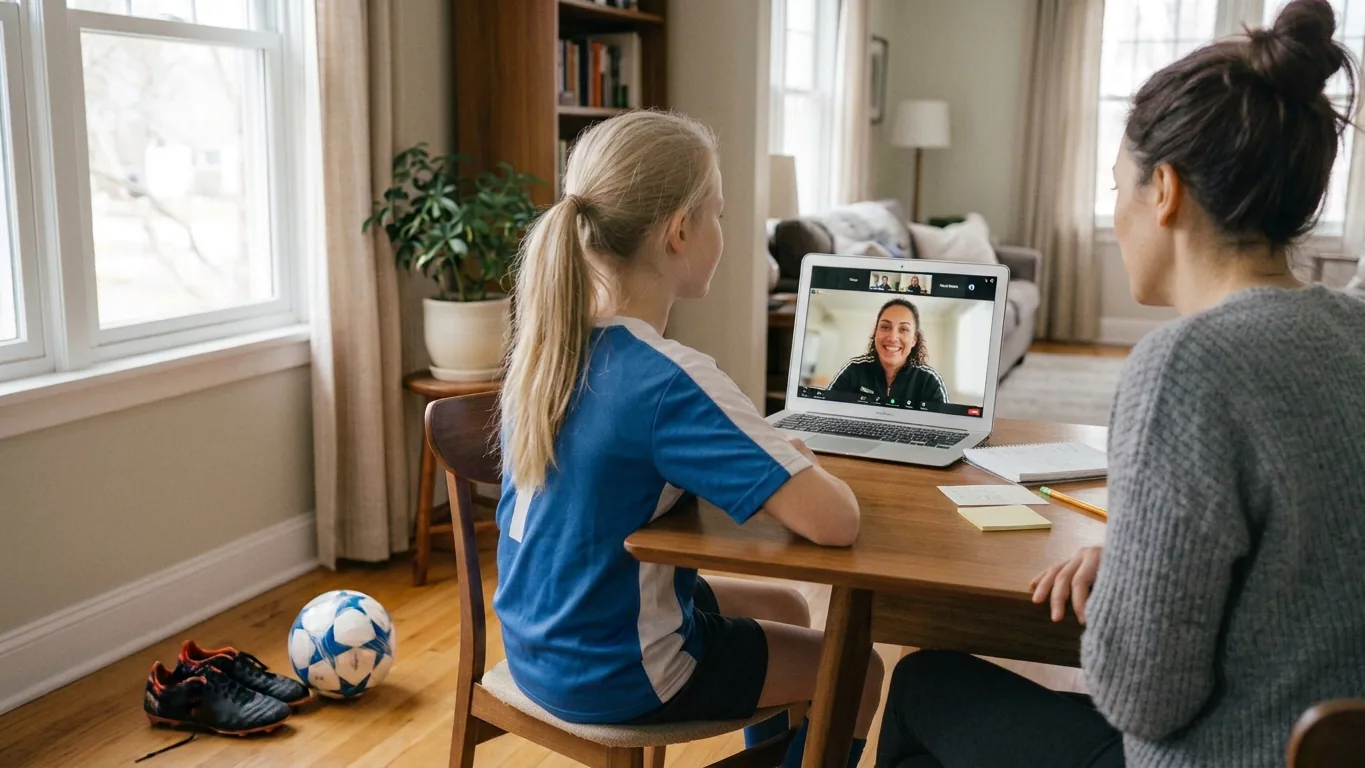
A sports psychologist is a licensed psychologist who can address both performance and clinical mental health concerns. A mental performance coach builds the mental skills behind performance, like focus, confidence, and composure, and does not provide clinical treatment. Most athletes looking for help with nerves, focus, or slumps need a mental performance coach. A licensed sports psychologist is the right fit when there’s a clinical concern, such as anxiety or depression that reaches beyond competition, disordered eating, or a mental health diagnosis. Either way, check credentials: “psychologist” is a legally protected title, and “mental performance coach” is not, so certifications like the CMPC are worth looking for.
This guide covers the difference between the two, which credentials matter, how to check them, and what to ask before you commit, including how to choose someone for a competitive teenage athlete.
Key Takeaways
- A sports psychologist is a licensed psychologist who can address both performance and clinical mental health concerns. A mental performance coach builds performance skills and does not provide clinical treatment.
- For nerves, focus, confidence, and slumps, a certified mental performance coach is usually the right fit. For concerns that reach beyond sport, start with a licensed professional.
- “Psychologist” is a protected title; “mental performance coach” is not. Look for a psychology license or the CMPC credential.
- You can verify both: psychology licenses through licensing board lookups, and CMPCs through the AASP directory.
- Be cautious of anyone who promises results or can’t clearly name their credentials.
Table of Contents
What’s the Difference Between a Sports Psychologist and a Mental Performance Coach?
A sports psychologist is a licensed psychologist who specializes in athletes. Because they hold a psychology license, they can assess and treat mental health conditions as well as work on performance. A mental performance coach builds the mental skills behind performance: focus, confidence, composure under pressure, and consistency. Coaches do not provide clinical treatment. The two roles overlap on performance work, but only one is licensed for clinical care.
| Licensed Sports Psychologist | Mental Performance Coach | |
|---|---|---|
| Education | Doctoral degree in psychology (Ph.D. or Psy.D.) | Often a master’s or doctoral degree in sport, exercise, or performance psychology or a related field |
| License or certification | Psychology license (required to use the title “psychologist”) | No license required; the strongest credential is the CMPC (Certified Mental Performance Consultant) from the Association for Applied Sport Psychology |
| Is the title protected? | Yes. Only licensed psychologists can call themselves psychologists | No. Anyone can use the title, which is why credentials matter |
| Main focus | Mental health and performance, including clinical concerns | Mental skills for performance: focus, confidence, composure, consistency |
| Clinical concerns | Can assess and treat mental health conditions | Does not diagnose or treat; refers to a licensed professional when needed |
| Best fit when | There is a mental health concern that reaches beyond sport, or a diagnosis is involved | The goal is performing better: nerves, focus, confidence, slumps, returning from injury |
What does a sports psychologist actually do for athletes?
A sports psychologist does two kinds of work. The first is performance work: helping athletes manage pre-competition anxiety, stay focused, rebuild confidence after setbacks, and handle the pressure of competing at a high level. The second is clinical work, which a coach can’t provide: assessing and treating mental health conditions that affect the athlete’s life beyond sport, such as persistent anxiety, depression, disordered eating, or the emotional weight of a serious injury. Many sports psychologists also consult with teams, coaches, and athletic departments.
What does a mental performance coach do?
A mental performance coach trains the mental side of sport much like a strength coach trains the physical side. The work centers on specific, learnable skills: visualization, attentional control, self-talk, breathing and arousal regulation, pre-performance routines, and resetting after mistakes. Good coaches measure where an athlete starts, build skills progressively, and test those skills in real competition. Some mental performance coaches also hold a counseling license. If so, they’ll tell you, and you can verify it the same way you would a psychologist’s.
Is a Licensed Sports Psychologist Better Than a CMPC for a Young Athlete?
Neither is better. They do different jobs. If your young athlete is dealing with nerves before games, losing focus in big moments, a confidence dip, or a slump, a certified mental performance coach is usually the right fit and the most direct path. If you’re seeing signs that go beyond sport, such as changes in mood, sleep, or eating, or pulling away from friends and activities they used to enjoy, start with a licensed psychologist or another licensed mental health professional.
Where are you seeing the concern?
Mostly in sport
Nerves before games, losing focus, confidence dips, slumps, coming back from injury.
A mental performance coach is usually the right fit. Look for the CMPC.
Beyond sport, too
Changes in mood, sleep, or eating, or pulling away from friends and activities.
Start with a licensed psychologist or mental health professional.
Not sure? A practice that offers both can match your athlete to the right professional.
For many families, the simplest option is a practice that offers both, so you don’t have to start over if needs change. A coach can build performance skills while a licensed psychologist oversees the work and steps in if a clinical concern comes up.
How to Choose a Sports Psychologist or Mental Performance Coach for a Competitive Teen
Step 1: Clarify the goal
Before you start searching, get specific about what you want to work on:
- Is your athlete struggling with performance anxiety or fear of failure?
- Do they want to improve focus and consistency in competition?
- Are they coming back from an injury and need help regaining confidence?
- Is the goal better team dynamics or leadership?
- Are there concerns that show up outside of sport, too?
Your answers tell you which kind of professional to look for. The first four usually point to a mental performance coach. The last points to a licensed professional.
Step 2: Look for experience with teenage athletes
Working with a 15-year-old is different from working with a college senior or a pro. Look for someone who works regularly with adolescents and uses age-appropriate methods, not an adult program scaled down. Ask how they involve parents. Good providers keep you informed while giving your athlete room to own the work.
Step 3: Check credentials
Confirm the license or certification before the first session, not after. The next two sections explain what to look for and how to check it.
Step 4: Evaluate fit through a consultation
A short consultation tells you a lot. Use it to ask the questions below, and notice whether your athlete feels comfortable talking with this person. Fit matters as much as credentials.
What Credentials Should a Legitimate Sports Psychologist or Mental Performance Coach Have?
For a sports psychologist: a doctoral degree in psychology (Ph.D. or Psy.D.) and an active psychology license. What separates a sports psychologist from a general psychologist is specialized training or experience in sport and performance psychology, so ask about it directly.
For a mental performance coach: look for the CMPC (Certified Mental Performance Consultant) credential from the Association for Applied Sport Psychology (AASP). To earn it, a consultant needs a master’s or doctoral degree in sport science, psychology, or a closely related field, required coursework, and hundreds of hours of mentored applied experience. They also have to pass a certification exam, follow AASP’s ethics code, and recertify every five years. A graduate degree in sport, exercise, or performance psychology is also a strong signal, especially alongside real experience coaching or competing.
Be cautious of anyone whose only credentials are a weekend certificate, a personal athletic résumé, or a vague “mindset coach” title with no training behind it.
How to Verify Whether a Practice’s Staff Are Licensed Psychologists or Mental Performance Coaches
- Ask directly. Ask which team members are licensed psychologists and which are mental performance coaches. A trustworthy practice will answer clearly and won’t blur the two.
- Get the exact credential. Ask for each person’s license type or certification, such as “Licensed Clinical Psychologist” or “CMPC,” not just “our team of experts.”
- Look up psychology licenses. Psychology licensing boards publish free lookup tools where you can search a psychologist by name and confirm the license is active.
- Look up the CMPC. AASP keeps a public directory of Certified Mental Performance Consultants. If someone says they’re a CMPC, they should be listed.
- Watch how titles are used. If a practice calls everyone on its team a “sports psychologist,” ask whether each one is actually licensed. Often they aren’t.
Questions to Ask a Sports Psychologist or Mental Performance Coach
- Are you a licensed psychologist, a certified mental performance consultant, or something else?
- Have you worked with athletes in this sport and at this level (high school, club, NCAA, elite)?
- How much of your work is with teenagers?
- What does your process look like from the first session on?
- How do you measure progress over time?
- How will you tailor tools like visualization, self-talk, or routines to my athlete?
- How do you keep parents informed?
- What happens if a concern comes up that’s outside your scope?
The last question is one of the most useful. A good mental performance coach knows where their role ends and has a clear plan for referring out or bringing in a licensed professional.
Red Flags to Avoid
- Promises of results. No one can promise a win, a scholarship, a roster spot, or a return-to-play date. Anyone who does is overselling.
- Title confusion. Someone calls themselves a sports psychologist but can’t name their psychology license.
- No verifiable credentials. No license, no CMPC, and no relevant graduate training.
- No structure. Vague “mindset” talk with no assessment, no plan, and no way to track progress.
- No clinical safety net. No answer for what happens if a mental health concern comes up.
Mental training should be grounded in science, just like physical training.
How MindBalanceSPORT Approaches This
We’re transparent about who does what. MindBalanceSPORT was founded by two licensed psychologists: Dr. Brenna Chirby, Psy.D., a Licensed Clinical Psychologist who developed Virginia Tech Athletics’ sport psychology program, and Dr. Virginia Jones, Psy.D., a Licensed Counseling Psychologist. They are the only members of our team we describe as psychologists. Our mental performance coaches hold graduate degrees in sport and performance psychology or closely related fields, and several are Certified Mental Performance Consultants (CMPC).
“The first question I ask families isn’t ‘psychologist or coach?’ It’s ‘what are you seeing, and where are you seeing it?’ If it only shows up on the field, we build skills. If it’s showing up at home and at school too, that tells us something different, and we make sure the right person is involved.”
Most athletes who come to us want to perform better under pressure, so they work one-on-one with a mental performance coach through The MBS Approach, our five-stage framework. It starts with a coach match and the MBS Mindset Assessment. Our founders oversee the standards behind that coaching, and if a clinical concern comes up, support is available through our licensed professionals or by referral, so families don’t have to start the search over. Curious what the work looks like week to week? Here’s what to expect from an MBS mental performance coach.
We train the other half of the athlete. If you’re not sure which kind of support fits your athlete, a free consultation is a good place to start. Schedule your call today!
Frequently Asked Questions
Do mental performance coaches need a license?
No. “Mental performance coach” is not a licensed or protected title, so anyone can use it. That’s why credentials matter. The most widely recognized one is the CMPC (Certified Mental Performance Consultant) from the Association for Applied Sport Psychology, which requires a graduate degree, mentored experience, and a certification exam.
Can a mental performance coach help with anxiety?
A mental performance coach can help an athlete manage performance-related anxiety, like nerves before competition or pressure in big moments, by building skills such as breathing, routines, and self-talk. Anxiety that affects daily life beyond sport should be evaluated by a licensed mental health professional.
Is “sports psychologist” a separate license?
No. A sports psychologist is a licensed psychologist who specializes in working with athletes. The license is a psychology license; the sport specialization comes from additional training and experience. At MindBalanceSPORT, co-founder Dr. Brenna Chirby is the practice’s licensed psychologist.
What is a CMPC?
A CMPC is a Certified Mental Performance Consultant, the leading credential for mental performance coaches. It’s awarded by the Association for Applied Sport Psychology (AASP) to consultants who hold a master’s or doctoral degree in a related field, complete mentored applied experience, and pass a certification exam. CMPCs follow AASP’s ethics code and recertify every five years. You can confirm someone’s status in AASP’s public directory.
What should I ask a sports psychologist or mental performance coach before booking?
Start with credentials: are they a licensed psychologist, a CMPC, or something else? Then ask whether they’ve worked with athletes in your sport and at your athlete’s level, how they measure progress, how they keep parents informed, and what they do if a concern comes up that’s outside their scope. A clear answer to that last question is one of the best signs you’ve found the right person.