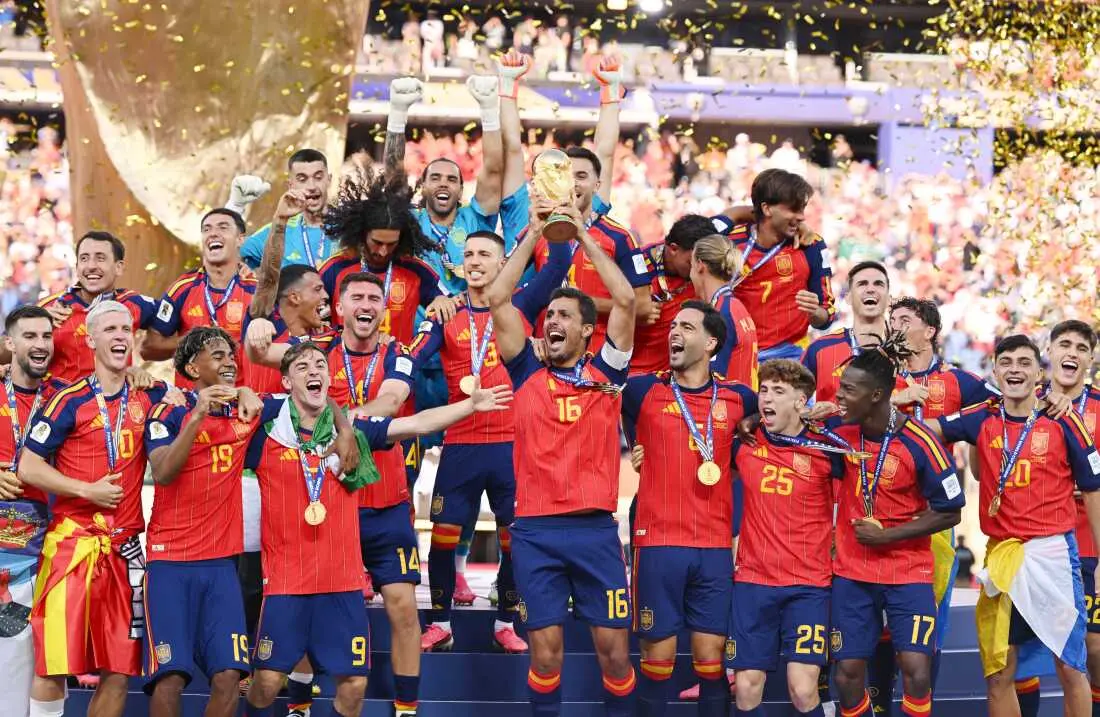
 The 2026 FIFA World Cup came down to a single goal. Ferran Torres scored in the 106th minute to give Spain a 1–0 extra-time win over Argentina in the final, capping a tournament in which nearly every knockout match was separated by fine margins. A saved penalty, a 90th-minute strike, a substitute who kept his composure when it mattered most precipitated the end result.Physically, the players at this level are nearly indistinguishable. What separated winners from eliminated teams was psychological. For coaches at MindBalanceSPORT, this isn’t surprising as the patterns align with decades of sport psychology research. Here is what this tournament showed us and how you can apply it regardless of your level of competition.
Arousal regulation decides shootouts
Penalty shootouts are a controlled test of an athlete’s mental strength and ability to reach their Zone of Optimal Functioning. Too little activation and reaction time slows; too much and fine motor control breaks down. According to Yuri Hanin, peak athletic performance occurs within a highly personalized “sweet spot” of emotional state and arousal. Some players perform their best penalty kicks slightly under-aroused and deliberate; others need a higher charge to strike the ball cleanly.
This tournament produced an unusually high number of shootouts, and the pattern held. Morocco’s win over the Netherlands turned on goalkeeper Yassine Bounou, whose saves came from a visibly practiced pre-kick routine rather than a reactive guess. Argentina’s shootout win over Switzerland was scrappy by comparison, with missed attempts on both sides — a signature of players whose arousal had tipped past their optimal zone under the weight of the moment.
Applied takeaway: Identify your own optimal arousal zone in practice — some athletes need a slow exhale and a fixed gaze on one spot, others need one sharp physical trigger like a clap or a stomp to get “up.” Centering before a penalty kick means using that same personal cue every time, so the walk to the spot becomes a rehearsed act of self-regulation rather than a moment you’re simply enduring.
Pre-performance routines create consistency under pressure
Consistency separates athletes who perform under pressure from those who merely practice well. Spain’s run to the title was defined by an unwavering defense and a squad that stuck to the same process match after match. Mikel Merino, introduced from the bench, scored the decisive late goal against Portugal in the round of 16 and again against Belgium in the quarterfinal. Coming off the bench cold, with no time to “settle in,” tests an athlete’s mental fortitude. However, Merino’s repeatability under those conditions is a textbook case of a pre-performance routine doing its job.
Applied takeaway: A routine isn’t just for starters. If you’re a substitute, a reliever, or anyone who has to perform without a warm-up period, your routine needs to be portable enough to run through mentally before you enter the field.
Resilience is trainable, not just a trait
Sport psychologists distinguish resilience – the capacity to maintain or recover performance after a setback – from simple toughness, because resilience can be built through structured exposure to adversity in training. Two matches from this tournament illustrate the power of resilience in athletics. Belgium trailed Senegal 2-0 at halftime in the round of 32 and came back to win 3-2 in extra time. Argentina trailed England 1-0 with ten minutes left in the semifinal and scored twice to win 2-1. Neither comeback was a fluke; both required players to remain tactical while behind, rather than abandoning structure out of panic.
Applied takeaway: Rehearse “losing positions” in training on purpose. Athletes and teams that have practiced executing a game plan while behind recover faster than those experiencing that stress for the first time in competition.
Self-efficacy compounds, and gets tested when it breaks
Self-efficacy, the belief in one’s ability to execute a specific task, is one of the most trusted predictors of performance and success. Lionel Messi entered his semifinal against England having scored in nine consecutive World Cup matches dating back to 2022. The streak ended that day, though he still recorded an assist and Argentina advanced. However, what happened when his streak broke is noteworthy. Messi’s contribution didn’t collapse; rather, he adjusted his role and still influenced the result. That’s the difference between confidence built on outcome alone and confidence built on trust in process, which holds up when the outcome doesn’t go your way.
Applied takeaway: Track process goals (decisions made, effort, execution) alongside results. Athletes whose confidence is anchored only to scoring or winning are the most fragile the moment a personal streak or result breaks.
Why This Matters Below the Professional Level
None of these findings are exclusive to elite athletes. They show up in youth club matches, high school playoffs, and weekend recreational leagues because the underlying nervous system response to pressure doesn’t change with the level of competition. What changes is preparation. The players who looked the most calm in the World Cup Championship game weren’t calm by accident; they had trained the mental skill the same way they trained a first touch or a free kick. That’s the model MindBalanceSPORT promotes, and it’s the model worth building into any training plan. Physical repetition earns you the skill, and mental repetition earns you the ability to use it when it counts.