Feeling nervous before a game is normal, and a little anxiety actually helps young athletes perform. Performance anxiety is different: it’s anxiety that starts to interfere with how your athlete plays, or whether they want to compete at all.
This guide covers the signs parents can watch for, what tends to drive performance anxiety, how to help without adding pressure, and when it’s time to get support.
It draws on a conversation MindBalanceSPORT co-founders Dr. Brenna Chirby and Dr. Virginia Jones had on The Special Ed Strategist podcast about helping young athletes handle pressure.
Key Takeaways
- Pre-competition nerves are normal and often helpful. Anxiety can become a performance problem when it interferes with how an athlete plays.
- Performance anxiety sometimes shows up in four ways: physical complaints, behavior changes, emotional changes, and negative self-talk.
- A common sign is an athlete who looks sharp in practice but plays well below that level in games.
- Parents help most by praising effort over outcome, keeping their child’s identity bigger than sport, and letting the athlete own their goals.
- If worry spreads into school, sleep, or friendships, or lasts for weeks, consider talking with a licensed mental health professional.
Table of Contents
Is It Normal for a Young Athlete to Be Nervous Before Games?
Yes, feeling nervous before a game is normal, and a moderate amount of anxiety usually helps young athletes perform.
At MindBalanceSPORT, we tell families that every athlete performs best with some anxiety, not none, and the right amount is different for each athlete. Think of a big test: a little worry can motivate your child studying, but too much makes it hard to think clearly.
Performance anxiety starts where that helpful worry tips over and begins to interfere with how your athlete plays. A 2025 clinical review in Translational Pediatrics draws the same line: performance anxiety differs from normal pre-competition nerves in how much distress and impairment it causes (Beenen, Vosters & Patel, 2025).
So the goal isn’t to make your athlete stop feeling nervous. It’s to help them use those nerves instead of being run by them.
"Being anxious before you perform is totally normal, and it's actually helpful. We all have an optimal level of anxiety for our best performance. It only becomes a problem when it starts to interfere with your performance."
How Do I Know If My Teenage Athlete Has Performance Anxiety?
The clearest sign of performance anxiety is worry that gets in the way of how your athlete performs, or of whether they want to compete at all.
We generally describe performance anxiety as showing up in the body, in thoughts, and in behavior. Parents usually notice it in four ways:
- Physical complaints. Headaches or stomachaches before competitions, especially when they become a pattern.
- Behavior changes. Suddenly not wanting to go to practice, or finding reasons to miss games.
- Emotional changes. Irritability, moodiness, or tears around the sport. In kids and teens, anxiety often comes out as irritability rather than “I’m worried.”
- Negative self-talk. “I’m going to mess up.” “I’m going to embarrass myself.” Our guide to quieting the inner critic when your child gets in their head goes deeper on this one.
Another common sign: your athlete looks sharp in practice but plays well below that level in games. Anxious athletes often perform below what they can do outside of competition.
Look for the trend, not the single moment. One stomachache before a championship game is nerves. A stomachache before every practice for a month is a signal worth paying attention to. You know your child best, so trust a pattern you notice.
What Causes Performance Anxiety in Young Athletes?
Performance anxiety usually builds when the pressure an athlete feels outweighs their confidence that they can handle it. At MindBalanceSPORT, we describe it as a gap between the demands on an athlete and how able they believe they are to meet them, which is also how sport psychology research defines it.
For young athletes, that pressure tends to come from a few places:
- Expectations from every direction. Coaches, parents, and teammates all add pressure. The pressure athletes put on themselves is often the hardest to see.
- Results that feel like a verdict. When a win or a loss starts to feel like a judgment on who they are, every game raises the stakes.
- An identity that’s all sport. If being an athlete is the whole picture, a bad game can feel like a bad self.
- Comparison. Teammates, rivals, and highlight reels on social media make it easy to feel behind.
- A full plate. Sleep, schoolwork, friendships, and a packed season all add up. The load can feel heavier for kids whose learning or attention challenges already make focus harder.
Research also suggests that athletes in individual sports, like tennis, swimming, or gymnastics, are more likely to experience performance anxiety than athletes in team sports.
Nerves vs. Performance Anxiety: What’s the Difference?
The simplest way to tell them apart: nerves fade once play starts and often help, while performance anxiety sticks around and gets in the way of playing.
| Feature | Normal Nerves | Performance Anxiety |
|---|---|---|
| When it shows up | Right before competition; fades once play starts | Before and during competition, sometimes days ahead |
| What it looks like | Butterflies, restless energy, extra focus | Stomachaches or headaches, avoiding practice, irritability, “I’m going to mess up” |
| Effect on performance | Often helps | Plays below their practice level in games |
| Enjoyment | Still loves the sport | May still love it, but competition feels threatening |
| What usually helps | Normalize it; a simple pre-game routine | Mental skills like breathing, self-talk, and visualization, often with a mental performance coach |
Not sure which one you’re seeing? Work through these four questions in order:
- Does it fade once the game starts? If the butterflies settle after the first few minutes, that’s usually normal nerves doing their job.
- Is it getting in the way? If worry is hurting how your athlete plays, or whether they want to compete, it looks more like performance anxiety.
- Is the enjoyment gone, even at practice? If the love of the sport has faded and your athlete seems worn out, consider burnout.
- Is it showing up outside sport? If worry, sadness, or irritability is affecting school, sleep, or friendships for weeks, talk with a licensed mental health professional.
If your answers point to burnout, our guide to student-athlete burnout explains how burnout differs from a bad week or performance anxiety, and what helps.
How Can Parents Help a Nervous Athlete Without Adding Pressure?
Parents help a nervous athlete most by praising effort over outcome, keeping the athlete’s identity bigger than sport, and letting the athlete own their goals. At MindBalanceSPORT, these are the habits we recommend most to families:
- Praise effort, not the score. Kids mirror what parents focus on. Talk about the score and they’ll fixate on the score. Notice effort (“I saw how hard you worked at practice this week”) and they’re more likely to focus on effort.
- Ask what motivates them. What does your athlete want to get out of playing? Open-ended questions help them reach their own conclusions instead of borrowing yours.
- Match your support to their age. Support can be emotional, practical, financial, or technical. A high school junior who knows what to work on may mostly need emotional support. A younger child usually needs all of it, including help protecting rest.
- Keep their identity bigger than sport. One of our favorite images: when we sit down to eat a pie, we don’t cut it in half. We cut it into many pieces. Your child is an athlete, but also a student, a friend, and a family member. Call it the pie mindset.
- Normalize setbacks. We like the phrase “win some, lose most.” Losing is a normal part of every athlete’s career, even at the top. More in our growth mindset guide for parents.
- Keep the ride home light. Save the game analysis, or let your athlete bring it up. Our guide to what to say instead of criticism has phrases that help.
- Let them lead the way back to fun. When nerves take over, it’s tempting to solve it for them: switch teams, call the coach. We suggest asking instead: “What do you still love about playing?” and “How do you want to make it fun again?”
When Is Performance Anxiety More Than a Sport Issue?
If worry, sadness, or irritability spreads beyond sport into school, sleep, appetite, or friendships, or lasts for weeks, talk with a licensed mental health professional.
For most performance worries, mental performance coaching is the right place to start. Coaching builds skills; it isn’t therapy and doesn’t replace clinical care. Sometimes, though, a performance block turns out to be part of something bigger. When that happens, MindBalanceSPORT has licensed mental health professionals on the team and can also refer families to an appropriate provider, so your athlete doesn’t have to start over somewhere new.
How MindBalanceSPORT Helps Young Athletes Manage Nerves and Pressure
MindBalanceSPORT teaches young athletes the mental skills to manage pressure through The MBS Approach, a five-stage framework that starts with a coach match and the MBS Mindset Assessment.
The assessment sets a baseline for areas like stress responses, self-confidence, and growth mindset. From there, your athlete’s coach builds skills such as visualization, breathing and stress regulation, self-talk, mindfulness, and goal setting, along with everyday foundations like sleep and time management.
Families are part of the process where it helps. We don’t believe in working with kids in isolation, because so much of how an athlete handles pressure is shaped by the people around them.
And because these skills generalize, they don’t stay on the field. Managing nerves at the free-throw line builds the same skills your child uses for a test, a recital, or a tough conversation with a coach. We train the other half of the athlete.
“Mental skills training is different from therapy, where we’re often talking about what’s going wrong. With mental skills, it’s fun. It’s positive. Our whole focus is to bring back the fun and teach kids how to do that themselves.”
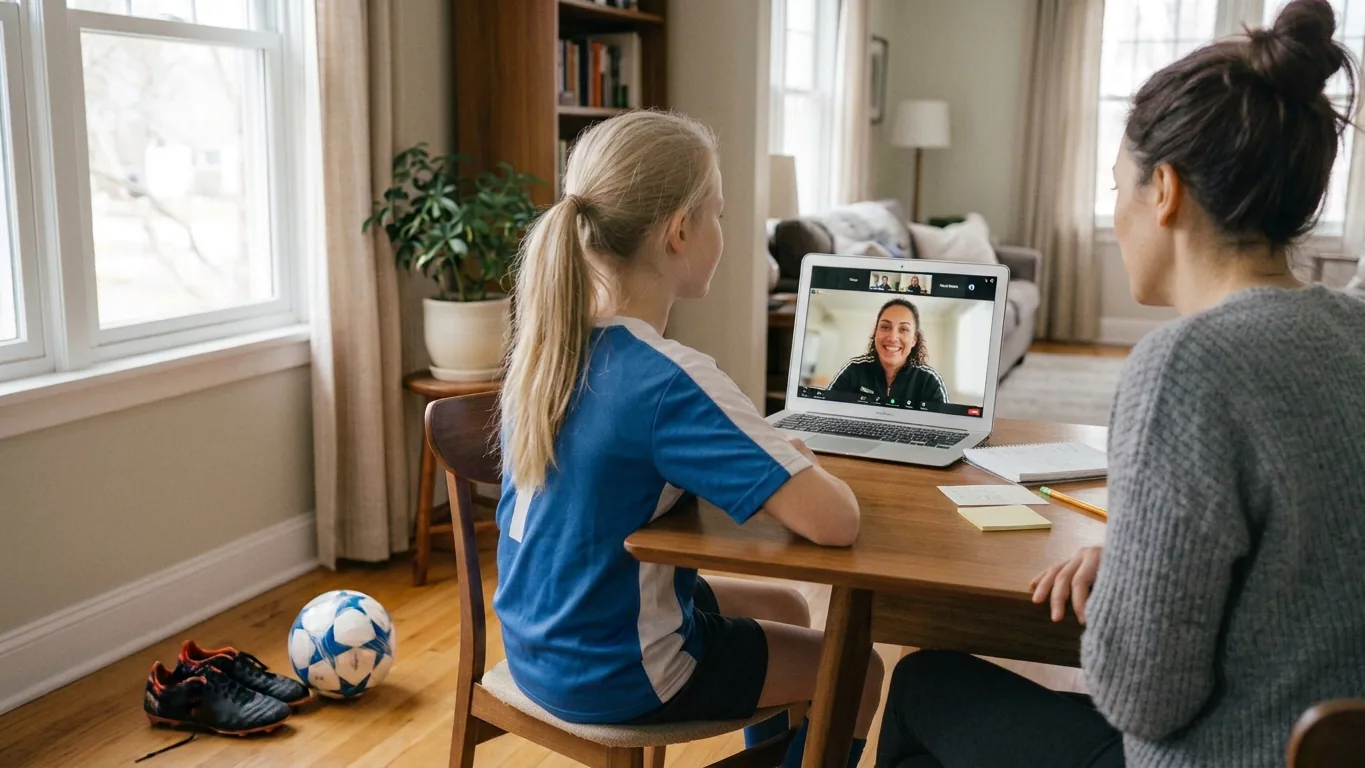
MBS offers mental performance coaching for youth athletes in person in McLean, VA and Plano, TX, and virtually nationwide. Start with a free consultation, and we’ll match your athlete with a coach suited to their sport, age, and goals.
Listen to the Full Podcast Episode
Dr. Chirby and Dr. Jones talk through performance anxiety, burnout, and building mental resilience in young athletes in episode 124 of The Special Ed Strategist podcast with host Wendy Taylor (March 2025). It’s a good listen for parents, coaches, and educators.
Frequently Asked Questions
Should I tell my child their feelings are normal?
Yes, and say it plainly: “Big games make everyone nervous. It means you care.” Naming feelings as normal takes away the extra worry about being worried. Avoid brushing it off with “It’s not a big deal,” which can make your child feel unheard. Then shift to what they can control, like their warm-up or one cue word.
Can kids get performance anxiety outside of sports?
Yes. The same pattern can show up before a recital, a chess match, a big test, or a tryout of any kind. The signs look similar: stomachaches, avoidance, and “I’m going to mess up” self-talk. The good news is that the mental skills athletes learn, like breathing, self-talk, and visualization, generalize to those moments too.
Does social media add to young athletes' performance pressure?
It can. Athletes compare themselves to highlight reels from peers and pros. We recommend building social media literacy, helping kids see that what’s online isn’t the full picture, and modeling healthy phone habits yourself. A simple rule worth trying: phones away before competition.
What mental skills does MindBalanceSPORT teach for pre-game nerves?
MBS coaches teach skills such as breathing and stress regulation, instructional self-talk, visualization, and pre-performance routines, plus how to reset after mistakes. Training starts with the MBS Mindset Assessment to set a baseline, and each athlete is matched with a coach who fits their sport and age. Coaching is available in person in McLean, VA and Plano, TX, and virtually nationwide.